
Working for a knitting shop means I chat to a LOT of knitters. Pre-knitters wanting to buy their first pair of needles and a ball of yarn, beginner knitters looking for knitting advice or their next knitting project, and experienced knitters who casually whip up cable knit jumpers and colourwork knits like it’s nothing.
A large part of working in a knitting shop is handing out knitting advice. Obviously, we sell a lot of yarn and needles and all the extra bits, but the majority of the day is spent chatting to the knitters who come in – about what they’re knitting, what knitting project is next on their list, what yarn their knitting with, what their favourite knitting needles are, figuring out what yarn to use for the knitting pattern they just downloaded, and so on.
Needless to say, I love chatting knitting and helping knitters with their problems. But there are certain topics that I find myself talking about more than others, especially when it comes to beginner knitters.
I could write for hours about knitting tips, but in the interests of keeping your attention, I’ll keep it to three. So here are the 3 pieces of knitting advice I think every knitter needs to hear, as someone who works for a knitting shop.
Look, I don’t want to get on my high horse here, but if you’re not knitting a swatch…
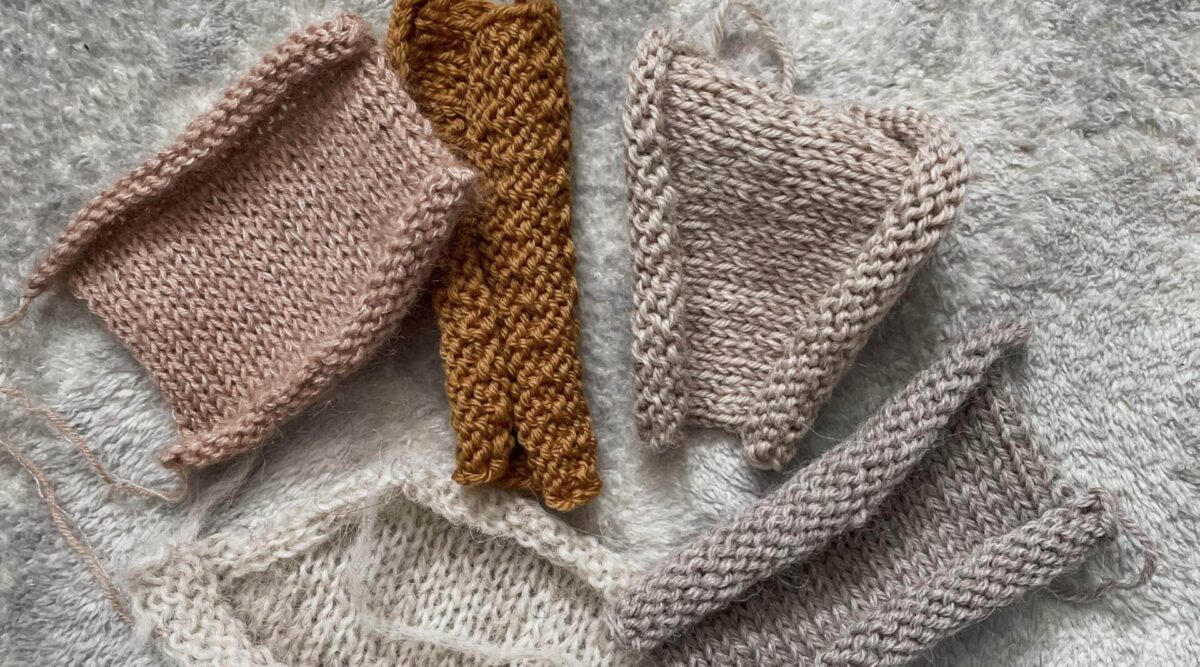
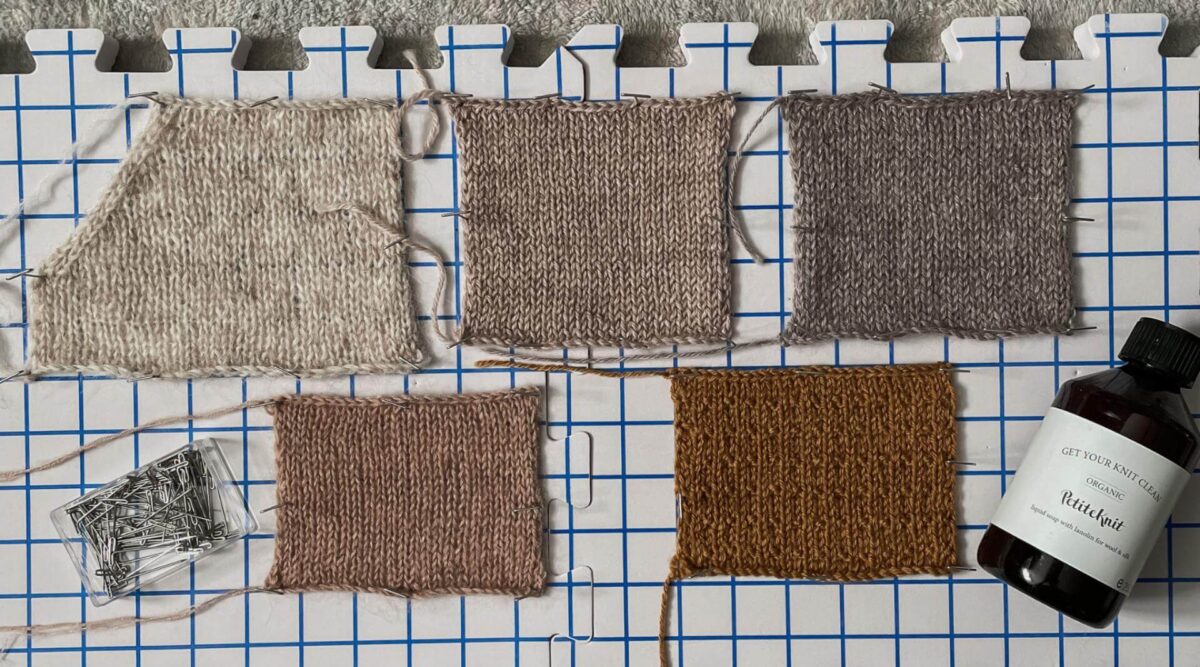
I know. Swatching is not the fun bit. You’ve chosen your knitting pattern, you’ve got all the yarn in front of you, you’re itching to start knitting that dream sweater, not a stupid little square, but please trust me when I say, the biggest and best knitting advice I could give you is to knit a swatch.
I have actually written an entire blog post about knitting gauge, and why swatching matters so much, so I won’t go on too much, but here’s the short version.
I often hear knitters saying, “Oh, I always meet gauge, so I’ll be fine.” Okay, cool… but, how do you know?
What knitters usually mean is that their tension tends to meet what is considered average. And yeah, about 22 stitches on a 4mm needle in a DK yarn is fairly standard, but:
Does your knitting create the fabric the designer intended for the pattern?
Some knit designs are a bit more forgiving, I’ll admit. Look at the Ranunculus Sweater by Midori Hirose, for instance. That knitting pattern can be worked up at wildly different gauges, so there is a bit more flexibility there. But then you’ve got designers like Sophie (The Knit Purl Girl), who has a very tight row gauge, or Jac Cieslak (Jaq Studio), who I’ve been told has a much looser tension.
So even if you think you usually meet gauge, you still need to swatch. Every single time.
(Okay, maybe I’ll let you off if you’re reknitting a pattern, or knitting with a yarn you’ve already swatched to the same gauge. That probably doesn’t count.)
I cannot tell you how important a swatch is. A gauge swatch tells you whether your knitting matches the pattern’s tension. And that means the difference between that dream handknit jumper you’re hoping to create and a knitted garment that could fit two of you… or half of you.
It also lets you get to know the yarn you’re about to spend a lot of time knitting with. You can see how the knitted fabric behaves, whether it’s drapey enough, dense enough, soft enough, and whether you even like how the colours look together.
Basically, it lets you check that everything is good and correct before you commit. Which is always a good idea.
If you’re a beginner knitter, I understand the temptation to reach for a ball of acrylic yarn. It’s cheap, and if you are just learning to knit, you might not want to shell out loads of cash on something you’re not sure you’ll stick with. That’s totally fair.
And if you’re about to embark on your first handknit sweater, it can feel daunting to buy that much yarn – especially if the pattern suggests something like merino plus mohair. You might want to ‘test’ your knitting abilities with a cheaper yarn, and actually, I am fully in support of that.
A sweater’s worth of yarn can be a chunk of money, but that doesn’t mean you need to knit with acrylic.
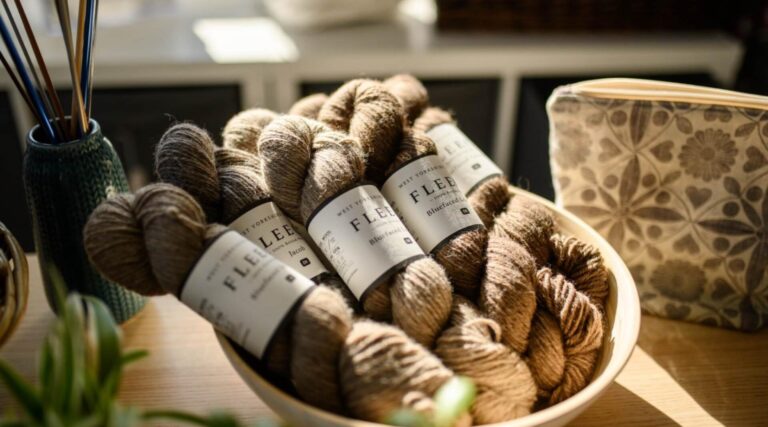
You can knit a proper wool sweater for a very reasonable price if you pick the right yarn, and it’s actually better overall…
Why? ‘Cause knitting with natural fibres means you can block your knits. And woweee does that make a difference.
I like to think of it like hair extensions. Wool is like your natural hair. You can plait it, it goes kinky. You wash it, and the kinks fall out. Synthetic hair extensions don’t behave the same way – and it’s exactly the same with yarn and blocking.
Wool blocks like a dream and it makes your knitting look at least 20% better. The fabric relaxes, your stitches get evened out, and the whole process can transform something that looks a bit, er… lumpy and bumpy, into something that looks, well, really flippin’ great.
And that’s a piece of knitting advice I wish I knew back when I made my very first ‘proper’ handknit cardigan – we’re about to go off on a slight tangent here, but I promise this personal anecdote is relevant to my point…
Years ago, I was a vegan knitter (must write about this sometime, too) with less disposable income than I have now. These two factors combined meant I was an acrylic knitter. So I bought a handful of Stylecraft Special Chunky to cast on a Novice Cardigan Chunky Edition by PetiteKnit. Cracker.
Except it wasn’t.
All those hours and hours of knitting and rows and rows of purl stitch, and I ended up with a handknit cardigan that looked more like a terrible bomber jacket than glorious, cosy cardi. It needed a really good block to relax the fabric, even everything out and just make it sit nicer.
And I couldn’t do it.
I felt betrayed by my own craft, and I wasted all that time, effort, and the money I spent on the yarn! I guess the moral of this tangent is: knitting with natural fibres, like wool, is 100% worth it. For many reasons, but if I had to pick one, it would be the fact you can block it.
I’m not slating acrylic completely. It has its place in the knitting world. But if you can wear wool and you’re happy knitting with it, my second piece of knitting advice is to do it.
If I had a pound every time I heard a beginner knitter say, “I’m learning to knit, so I’m going to knit a scarf,” my yarn stash would need its own room.
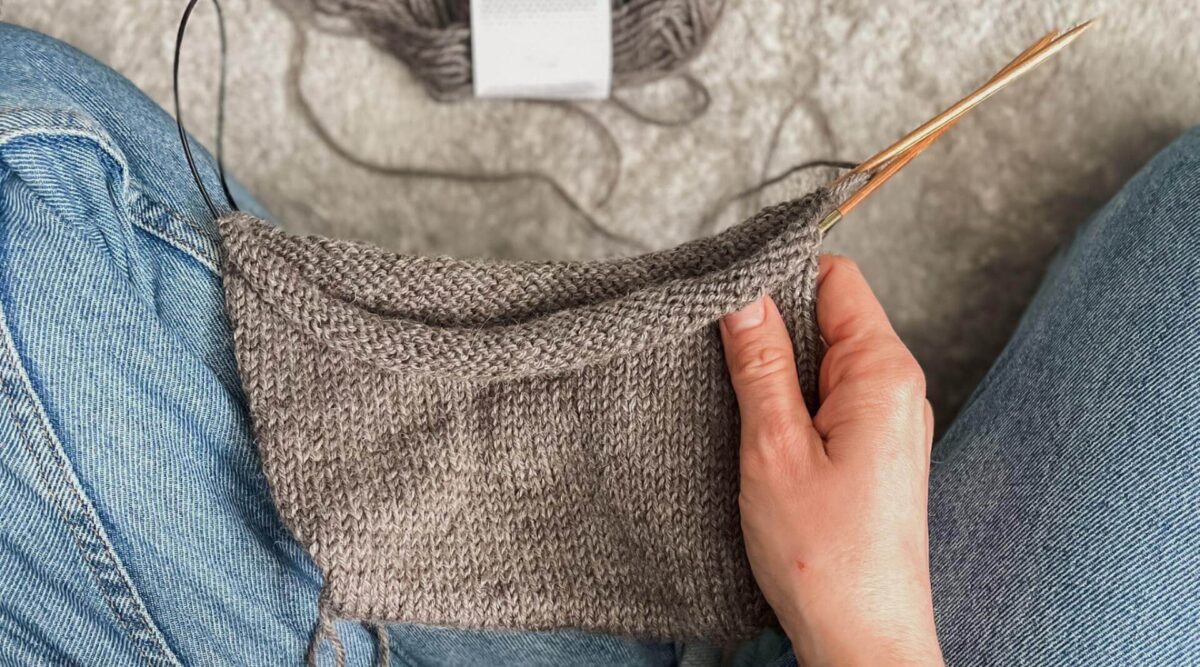
And I get it. A garter stitch scarf is easy peasy. You just knit every row, there’s nothing hard about it. But scarves are long. Which means a lot of knitting. And if you’re knitting the same stitch over and over, that can get boring.
Not always, but it can.
Don’t get me wrong. If you really, really want to knit a scarf, crack on. If there’s a genuine purpose or drive behind it, you’ll finish it and be chuffed with it. But if you’re knitting a scarf because it’s ‘easy’ or ‘that’s what beginner knitters do’, it might be worth considering something else.
(One exception is the Sophie Scarf by PetiteKnit. I actually love this knitting project for beginners, but mainly because (to support my point) it’s small).
Finishing a knitting project is incredibly motivating. Casting off and wearing something you’ve made… ooh, it feels good. So, my third piece of knitting advice is to start small for more of those dopamine hits.
That might mean starting with a snood, or a headband. Then moving onto knitting in the round with a hat, or a hot water bottle cover. Small knitting projects that you can finish fairly quickly and learn from before moving on to the next.
You’ll pick up more knitting skills in a shorter space of time, feel more confident, and be far more likely to like knitting and stick with it. Which means you’ll eventually be ready for all those sweater knitting patterns you’ve got saved on Pinterest or have screenshotted on your phone.
And that’s way better than having a half-finished knitting project sitting at the side of the sofa, or getting lost in the messy cupboard ‘cause you got bored knitting and knitting and knitting rows of 30 stitches for 2 whole metres.
I really, really hope so – and I’ll step off my soapbox now.
Working for a knitting shop, I like to think I give pretty decent knitting advice – but you don’t have to listen to me. Everyone has their own opinions when it comes to knitting, and these are just mine.
But if you got to the end of this knitting blog, firstly, thank you – I honestly appreciate you reading my knitting waffle. But, secondly, I hope that you can take just one piece of knitting advice away with you to make your knitting, just, well, better!
Was there something I said that resonated with you? Or perhaps you have a piece of knitting advice that you think other knitters should hear to? If so, let us know – we always love a knitting chat!
To provide the best experience we use cookies to store and/or access information. Consenting will allow us to process data on this site. Not consenting may adversely affect certain features and functions.