
So you’ve decided on your next knitting project: the jumper of dreams, the cosy cardigan, the colourwork masterpiece that you’ve been eyeing up for months. But sadly, the decision making isn’t over – you still need to choose the right yarn for your knitting project.
Obviously, every knitting pattern will have at least one suggested yarn to work with. Let’s take the knitting patterns I am working with now as an example: the Hanstholm Sweater by PetiteKnit suggests Sandnes Garn Peer Gynt, the Baby Aosta by The Knit Purl Girl suggests Sandnes Garn Double Sunday and the Briskeby Slippers by Guri Pedersen suggests Lamana Como Grande.
It might be that your local yarn shop doesn’t stock Sandnes Garn or you want to choose a machine washable yarn for a baby knit or maybe you just want something that feels different – softer, denser, drapier, or you want to use something from your stash OR, maybe you’re a beginner knitter who’s embarking on their first sweater project and the wall of wool in front of them is starting to look a little bit overwhelming.
Merino, Mohair, Alpaca, British wool… can you not just pick something and start knitting?!
Choosing a yarn isn’t just about fibre: you wanna think about gauge etc too, but that’s a whole post of its own (that I’ll probably write up soon), so today I wanna chat about getting to know the fibres themselves, so that when you’re choosing a wool yarn for your knitting project, you can pick something from your local yarn shop with confidence.
Strictly speaking, if a pattern suggests an animal fibre, you’ll usually want to stick with an animal fibre.
This isn’t to say you can’t knit with plant-based fibres, and I completely understand why you might choose to omit animal fibres from your yarn stash (if you’re a vegan knitter, for instance), however, it’s important to note that plant-based yarns act completely differently to animal-based fibres, even at the same weight. They have different elasticity or memory that will affect your FO, etc.
In the interests of not allowing this knitting blog to become a knitting dissertation, I’m going to stick with talking about animal fibres. So here’s a quick-ish rundown of different wool types that you might see at your local yarn store and their characteristics so you can choose the right wool yarn for your knitting project.
Let’s go!
As a general rule, the colder the place the sheep is from, the hardier they need to be. Here in the UK, it’s not cold (well, not right now after a record breaking heatwave), but it’s not usually hot either, so the sheep need a bit of protection. This means their fleeces produce a wool that has a bit of grit. A bit of rustic, woolly, toothiness that knits up a treat.
It’s not merino or alpaca soft, but you can get some pretty lustrous fleeces. Blue Face Leicester (BFL), for instance, is famously lustrous; Masham sheep are also pretty lovely and together combine to create something quite beautiful – like Laxtons Sheepsoft, for instance. It’s a proper woolly wool, a bit of toothiness and structure, but with a nice softness as the name suggests.
That toothiness and structure I mentioned also means British wool can create a really nice and defined knitted fabric. Cables, colourwork and textured stitches can really pop, and the finished knit tends to have a bit more body than something made from a very soft, drapey fibre. Of course, this varies massively between breeds and yarns, but that’s also one of the benefits of British wool – there’s SO many different breeds you can try.
Speaking of sheep, it’s worth mentioning that many British wools also come with a gloriously ‘sheepy’ smell. We love it, but it’s not for everyone…
I honestly think British wool is good for pretty much anything, but particularly for warmer jumpers, or layers that won’t necessarily be next to your skin (obvs depends on your tolerance. I can wear some, but find others a little prickly, and since I don’t know yours personally, I’m playing it safe!).
Knitting patterns like Lauder by Rebecca Clow, with all those delicious cables, or Rhue Sweater with the colourwork would lend themselves well. And if you love British wool and feel passionate about using local fibres, Marina Skua created a whole collection of unisex knitting patterns dedicated to British wool yarn which might be right up your street..
Like Baa bestseller and favourite Jamieson’s of Shetland Spindrift.
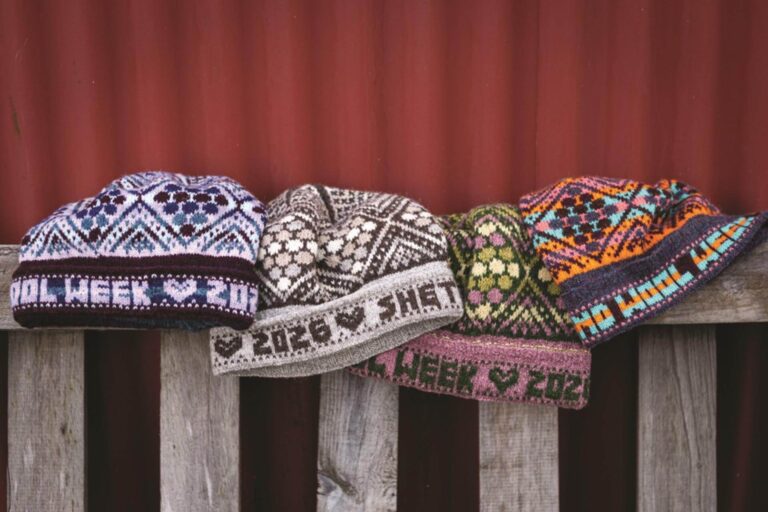
Shetland is renowned for its wool – they even have a Shetland Wool Week every year that celebrates the local textile industry and the incredible Shetland sheep. It’s a terrific wool with lots of texture, a bit rustic and gritty and full of character. Makes for a superb jumper that is going to last you a lifetime, that sort of thing.
One of the things I love about Shetland wool is that it can create a fabric that’s warm without being ridiculously heavy. It’s got plenty of structure and lovely stitch definition, which is one of the reasons it’s so flippin’ nice for colourwork knitting.
Oh, and if you’re on the fence about how rustic it feels straight from the ball, Shetland wool can soften and bloom after washing so it’s worth giving it a swatch to see if it’s the yarn for you.
Stranded colourwork is where Shetland wool really works, but I’d also choose it for garments with a bit more structure, like some warm, dense mittens.
Now, I can hardly suggest knitting projects without mentioning the Shetland Wool Week hat designs, can I? Shetland wool is exactly what the SWW hats were created for, just like the 2023 design, Buggiflooer Beanie by Alison Rendall, which is Janice’s fave.
I’d also like to shout out Wandrian by Dianna Walla, which is a completely beautiful colourwork cowl that wouldn’t be for everyone, but is exactly what Shetland wool is good for – warm, lightweight knits and fantastic colourwork. If you have a high tolerance for woolly wool, ooft, it’s a beauty!
Not for the fainthearted, Icelandic wool, like Lopi’s Lettlopi, is a classic ‘wool wool’. Iceland is COLD, so the fleece is about as far away from those luxuriously soft merinos and cashmere as you can get. My brain says yes, but my baby skin says no…
Famously used for traditional Icelandic sweaters, this yarn creates weatherproof garments designed to withstand even the harshest of temperatures – you know they’re gonna keep you WARM. You might not want to wear them against your skin, but then again, in the depths of winter, you’ll probs be wearing a long sleeve underneath anyway.
Icelandic wool has a fantastic toothiness and grips itself like nobody’s business. If you drop a stitch, you could leave it for a week and come back to it, and it’ll still be there. Seriously, it practically knits itself.
Despite its heavy, rustic look, a big sweater knit in Icelandic wool can be surprisingly lightweight, so it’s a particularly good yarn choice for a proper outer layer that’s not suuuper heavy.
Icelandic wool was made for outer layers to keep you as cosy as can be. Big knitted garments like a coatigan – The Field Day Jacket by Ozetta would be a DREAM in a chocolatey brown – or a nice warm jumper for the Scottish winter, like the Nova Sweater by The Knit Purl Girl, which is free to download on Ravelry.
And obviously you can go all out with a classic Icelandic sweater – Riddari, a knitting pattern released by Lopi has to be one of their most popular designs, and you’ll find loads by Linka Neumann in her knitting book Wilderness Knits, too
Now, as I said, not all wools are created equal. I’ve heard a lot of people say, ‘Oh, I can’t wear wool’, but 80% of the time, they just haven’t found the right one, and merino is usually a pretty safe bet.
Generally speaking, merino wool is soft and smooth and very, very easy to knit and wear. Like Ulysse by De Rerum Natura. It’s a brilliant all-rounder and you can’t really go wrong. It has enough elasticity and structure to make fitted garments, but also has that nice softness so you can easily wear it next right next to your skin.
To be honest, I think you could pick merino for knitting pretty much anything. Perfect for big cosy jumpers, like Olga Sweater by PetiteKnit or Sibling Sweater by Laura Penrose (I appear to have a bit of a stripe hype going on here…) or for any knitted accessory, a Musselburgh Hat by Ysolda, for instance or the Last Minute Handstulpen by Susanne Muller that I’m about to swatch for. I’ve even seen it used for summer tops like Camisole no.9 by My Favourite Things Knitwear, which doubles up as a base layer in winter veeery nicely.
Quite often, superwash-treated yarns are merino, like Lang Merino 120, which is one of our best-selling yarns here in our Stonehaven knitting shop, and a lot of hand-dyed yarns too. But you can also get other kinds, like some British wools and the majority of sock yarns, too..
These yarns can be beautiful to knit with, but aren’t necessarily the most forgiving since they tend to show up gauge variations or loose stitches thanks to their smooth superwash-coated fibres.
They also have a tendency to grow…See, superwash yarn is treated with chemicals or resin that removes or covers the microscopic scales on the wool fibres. Without those scales gripping one another, the fibres slide past each other. So stitches relax and stretch, and then stay stretched out when it gets wet. Yet another reason why we always wash and block our swatches before casting on…
That said, in the case of our Lang Merino 120, it’s soft as a cloud, washes well and, like many superwash yarns, is great for growing children!
Baby knits/children’s garments and superwash yarns go hand in hand. Or at least knitting projects that can deal with a little bit of growth. It’s not everyone’s cup of tea, and if I’m honest, I do think some are better than others, but for baby knits you can’t really go wrong. And if you want some pattern inspo, check out my list of 8 tried and tested baby knitting patterns you’ll want to knit again and again
Knit with as a single fibre, Alpaca wool grows, so it’s often blended with a wool or silk to give it structure, or held with a stabilising yarn, like mohair, to help keep its shape.
Alpaca yarn is SOFT; it has a light halo and is generally pretty damn lovely to wear. The softness does mean it pills like nobody’s business, but persevere with the upkeep and combing and it will get better.
Alpaca also has more drape than a typical wool yarn, so the knitted fabric can feel all fluid and floaty rather than springy and structured. That lack of elasticity is one of the reasons it grows and, as I said, why it’s often blended with wool. So you get the softness and drape of alpaca with some of the bounce and structure of wool. Kinda like 50/50 bread where it’s supposed to give you the best of both worlds.
Alpaca yarns are fantastic for super soft accessories and garments where a little bit of fuzzy warmth is welcome. I’m thinking a nice cosy cardigan, such as Cardigan No.11 by My Favourite Things Knitwear, Cloud Sweater by PetiteKnit or Berlin Scarf by Susanne Muller.
Beautiful!
Ah, cashmere. If wool has a top tier, this is it. It’s ridiculously soft, drapes like an absolute dream, and honestly, once you’ve knit with it, everything else feels a bit rougher by comparison (soz, lettlopi, but you just can’t compete).
It won’t be the cheapest option in your local yarn shop, and I wouldn’t necessarily recommend it for your first ever jumper (there’s too much heartbreak if something goes wrong), but for a special gift knit, or a small luxurious knitting project you’ll love and wear forever, it’s worth every penny.
It is worth mentioning too, that cashmere ain’t exactly the hardiest of fibres, so you really would want to save it for those special knits, rather than a sweater you chuck on to go de-weed the garden or whatever.
If budget allows, I’d recommend cashmere yarn, like Lang Premium Cashmere for those small, special knitting projects where the extra softness will genuinely make a massive difference. Knits like a cloud-soft scarf, a beanie, or fingerless mitts. Something that sits close to your skin, so that you get to feel every single penny that went into it!
I think the Sophie Scarf by PetiteKnit (or similar) is a great starter project, especially if you wanna knit something spesh, but only wanna treat yourself to one ball. Or even the Penny Gloves by PetiteKnit if you can stretch to an extra. But if you’ve got the yarn budget to go all out, you just know a sweater, like the Olga Blouse by PetiteKnit, would be an absolute DREAM to knit and then subsequently wear every day of the rest of your super soft life.
Finally, we have mohair. Now, mohair is kind of a different category entirely. It tends to be lace weight, so very fine, but with a very fuzzy halo.
Mohair, like the Kremke Silky Kid and Hjertegarn we currently have in store in our Stonehaven knitting shop, adds warmth without weight and is often used held together with a base yarn, or knit holding two (or more) strands together.
Held double, it creates the lightest, drapiest knitted fabric, that is surprisingly warm. Fantastic for cardigans and jumpers that are a bit more spesh and floaty and fuzzy.
Held with another yarn, it adds softness, and bumps the weight of the yarn up to the next category (4-ply to DK for instance), providing drape and volume without extra weight. It also gives the finished knit a slightly hazy, fuzzy look, softening the stitch definition and adding a little bit of luxury to a plainer base yarn
Because mohair is so soft and luxurious, it’s perfect for the lightest of light garments that are warm, but supremely elegant. The kinda thing you can wear going out out and feel FANCY, you know? Hold with a base yarn for something like the Late Summer Wrap by Pernille Larsen… absolutely wedding worthy. Or knit with it held double for something cosy and super light, like Cumulus Blouse by PetiteKnit.
It’s really nice for making simple garments look, less simple? Probs wouldn’t be my first pick for a knit with loads of texture or cables, just because I’d want people to see all my hard work, you know?
I’ve said it before and i’ll say it again – wash and block your knits. Always. Blocking makes everything a billion times better and it gives you an idea of what the wool yarn you choose is actually like.
Kinross 4ply by Wee County Yarns, for example, is a lambswool that contains spinning oil. So, the yarn is nice and crisp when you first knit it up, but once washed, the fabric blooms and softens like butter, transforming it into a fibre almost as soft as cashmere.
This is also why we wash and block our swatch before we cast on. ‘Cause we’re all knitting a swatch, right??
Honestly, this is gonna be the most frustrating conclusion because really there isn’t one right answer.
It depends on what you’re making, who it’s for, and how you want it to feel against your skin. Maybe you want a baby-soft merino for a newborn, or a toothy Icelandic wool for your first steeking project. The best wool for your knitting project is simply the one that matches the job it needs to do.
So next time you’re assessing your yarn options feeling a bit overwhelmed, hopefully this gives you a starting point. Good luck!
To provide the best experience we use cookies to store and/or access information. Consenting will allow us to process data on this site. Not consenting may adversely affect certain features and functions.